Enterprise SEO vs. Traditional SEO: What Large Scale Brands Need to Know
Discover the critical differences between Enterprise SEO and traditional SEO, from crawl budget management to programmatic content execution at scale.
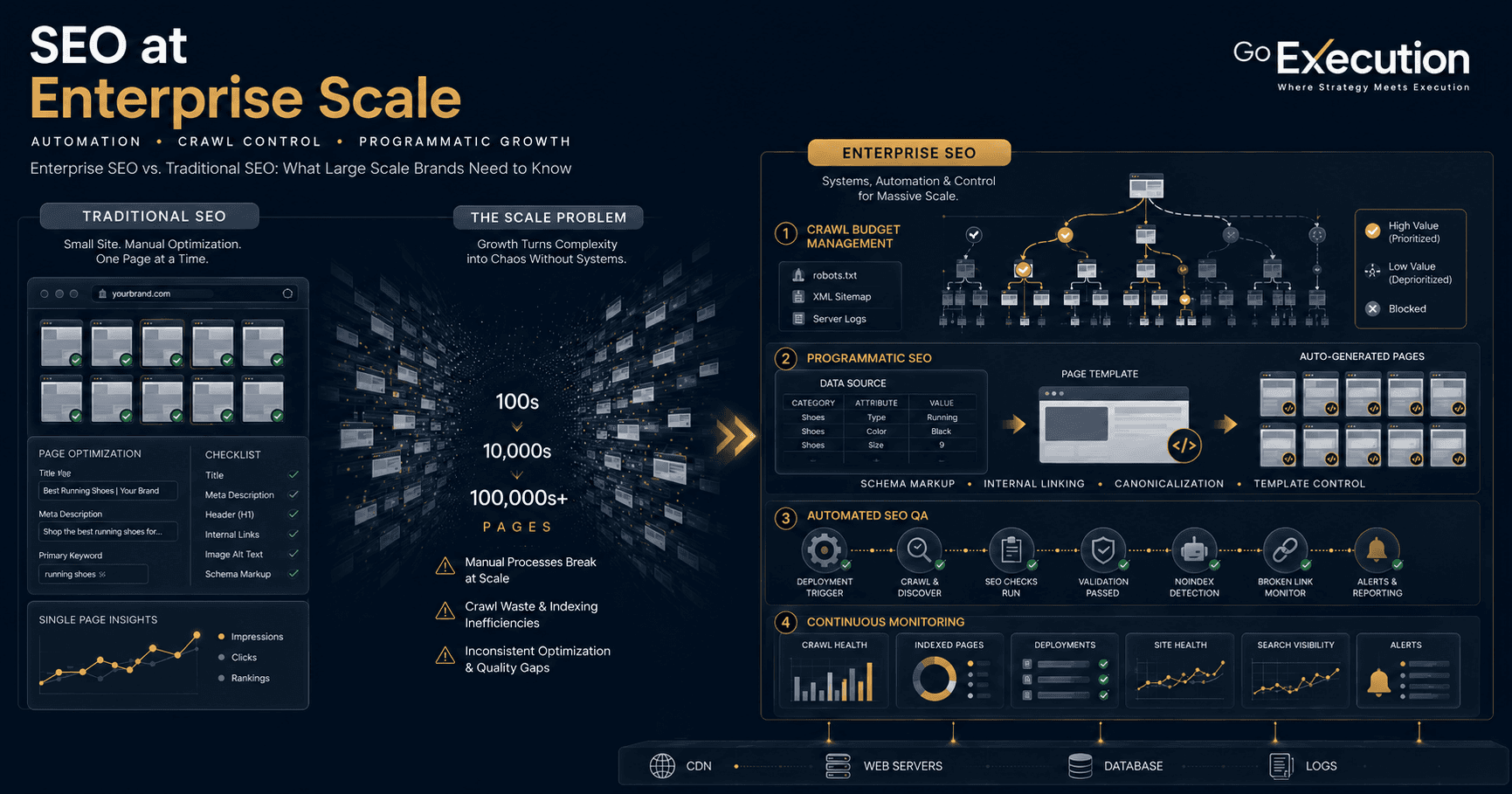
When a website scales from a few hundred pages to hundreds of thousands—or even millions—the rules of search engine optimization fundamentally change. Enterprise SEO is not just traditional SEO applied to a larger site; it is a completely different discipline requiring advanced technical infrastructure, cross-departmental alignment, and scalable automation.
The Scale of the Problem
Traditional SEO focuses heavily on individual page optimization: writing perfect title tags, manually acquiring backlinks for specific pages, and tweaking individual meta descriptions. For a 50-page local business site utilizing Small Business SEO Services, this is effective, whereas multi-location brands require specialized local SEO for franchises.
For an enterprise site (like a massive storefront requiring dedicated Ecommerce SEO Services, a global software platform executing a B2B SaaS SEO strategy, or a major publisher), manually optimizing individual pages is mathematically impossible. Enterprise SEO shifts the focus from the micro to the macro—creating programmatic templates, fixing sitewide technical bottlenecks, and managing how Google bots interact with your server.
1. Crawl Budget Management
One of the biggest differentiators in Enterprise SEO is Crawl Budget. Google does not have infinite resources; it allocates a specific amount of time to crawl your site. If your site has 500,000 pages, but Google's crawl budget for your domain is only 10,000 pages a day, it could take months for new products to be indexed.
Enterprise SEOs must aggressively manage crawl efficiency by applying core principles of Technical SEO:
- Eliminating infinite crawl spaces (like faceted navigation filters that generate endless URL combinations).
- Optimizing server log files to see exactly where Googlebot is wasting time.
- Using advanced
robots.txtdirectives and dynamic XML sitemaps to herd bots toward high-value pages.
2. Programmatic SEO and Automation
You cannot manually write 100,000 title tags. Enterprise SEO relies on Programmatic SEO—the creation of scalable, database-driven templates that automatically generate perfectly optimized pages.
For example, a travel enterprise might build a programmatic template for "Flights to [City]". The SEO team dictates the logic, schema markup, and dynamic data integration (fetching real-time prices), and the development team executes it. This is why our Custom Web Development and Technical SEO teams work in tandem.
3. Protecting Authority During Constant Deployment
Enterprise sites are updated constantly. Agile development teams might deploy new code daily. Traditional SEOs audit a site once a month; Enterprise SEOs build automated testing pipelines to catch regressions before they hit production, following the rigorous protocols used when learning how to redesign a website without losing SEO.
If a developer accidentally pushes a noindex tag to the global header template, an enterprise could lose millions in revenue overnight. Enterprise SEO requires setting up automated monitoring and alerting systems to safeguard the site's architecture.
Is Your Organization Ready for Enterprise SEO?
Executing an enterprise strategy requires a partner who understands complex architectures, server-side rendering, and big data analysis. Compare top providers in our Enterprise SEO Agencies Comparison, learn how Go Execution handles massive web properties on our SEO Services hub, or contact us for an enterprise audit.