Why Next.js is Replacing Headless Shopify for Enterprise E-commerce
Explore why enterprise e-commerce brands are migrating from headless Shopify to custom Next.js architectures for superior performance, SEO, and flexibility.
In the fiercely competitive landscape of enterprise e-commerce, milliseconds directly translate to millions in revenue. For years, "Headless Shopify" was the buzzword for brands outgrowing the standard Shopify Liquid templates. However, a massive shift is occurring: enterprise brands are now bypassing standard headless setups and migrating to custom Next.js architectures.
The Limitations of Standard Headless Shopify
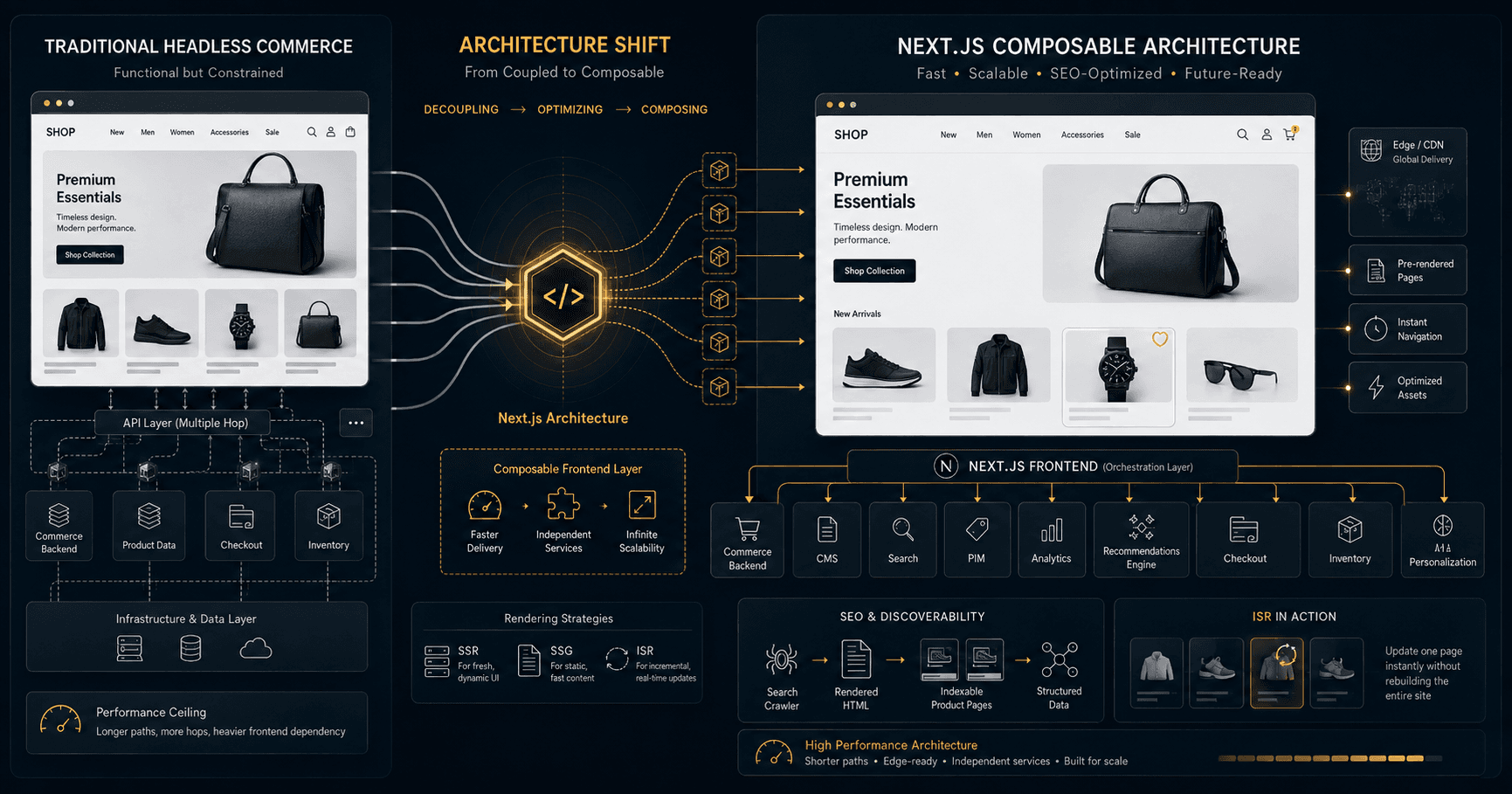
Headless commerce separates the frontend presentation layer from the backend e-commerce engine. While Shopify provides robust backend APIs (the Storefront API), relying on a basic React or Vue SPA (Single Page Application) frontend introduces several critical bottlenecks—as detailed in our review of why Reddit developers hate headless Shopify:
- Client-Side Rendering (CSR) Issues: Standard SPAs load a blank HTML shell and fetch data on the client side. This causes poor First Contentful Paint (FCP) and disastrous SEO, as search engine bots struggle to index dynamic product pages reliably.
- Vendor Lock-in: Relying entirely on proprietary frontend frameworks provided by e-commerce platforms can limit your ability to integrate complex third-party tools, like advanced PIMs (Product Information Management) or bespoke AI recommendation engines.
- Performance Ceilings: As product catalogs grow to tens of thousands of SKUs, client-side data fetching becomes visibly sluggish, increasing bounce rates.
Why Next.js is the Enterprise Standard
Next.js, the React framework developed by Vercel, solves the inherent problems of standard headless setups through intelligent rendering strategies. Here is why it has become the gold standard for enterprise e-commerce:
1. High-Performance Page Loads via SSR and SSG
Next.js offers both Static Site Generation (SSG) and Server-Side Rendering (SSR). This means product pages can be pre-rendered on the server or generated at build time. When a shopper clicks a product, they receive fully formed HTML instantly via a CDN. The result? Near-instantaneous page loads that effortlessly pass Google's Core Web Vitals. Explore our dedicated website speed optimization services to see how high-performance performance drives customer retention.
2. Flawless Technical SEO
Because pages are pre-rendered on the server, search engines like Google can crawl and index your entire catalog immediately. Next.js also allows for dynamic metadata routing, ensuring every variant, category, and product page has perfectly optimized title tags, meta descriptions, and rich JSON-LD schema markup. Pairing this with specialized ecommerce SEO services and our foundational principles in what is technical SEO drives dominant category rankings. Learn more on our Next.js Development Services page.
3. Incremental Static Regeneration (ISR)
Historically, pre-building a static site for an e-commerce store with 50,000 products would take hours. Next.js introduced ISR, allowing you to update static pages in the background without rebuilding the entire site. If a product goes out of stock or the price changes, Next.js instantly updates the specific page cache while the user browses seamlessly.
4. Ultimate Composable Architecture
By using Next.js, your frontend becomes entirely agnostic. You can use Shopify for checkout and inventory, Contentful or Sanity for editorial content, and Algolia for search. Next.js stitches these microservices together perfectly, future-proofing your stack so you can swap out backend providers without touching the UI.
The ROI of Migrating to Next.js
Migrating to a Next.js headless architecture is an investment in scalability. Brands that make the switch consistently report:
- Double-digit increases in mobile conversion rates, especially when paired with continuous conversion rate optimization (CRO) services.
- Drastic reductions in bounce rates due to high-performance perceived load times.
- Significant boosts in organic search traffic from improved Core Web Vitals.
Are you ready to break free from performance ceilings? Discover how our team engineers enterprise-grade storefronts on our Ecommerce Web Development and Custom Web Development Services pages, or see our review of top Next.js development agencies for enterprise ecommerce before you schedule a consultation.