
WordPress vs Next.js for Business Websites: A Performance Comparison
Compare WordPress CMS and Next.js React framework for speed, security, SEO rendering, content management, and scaling.
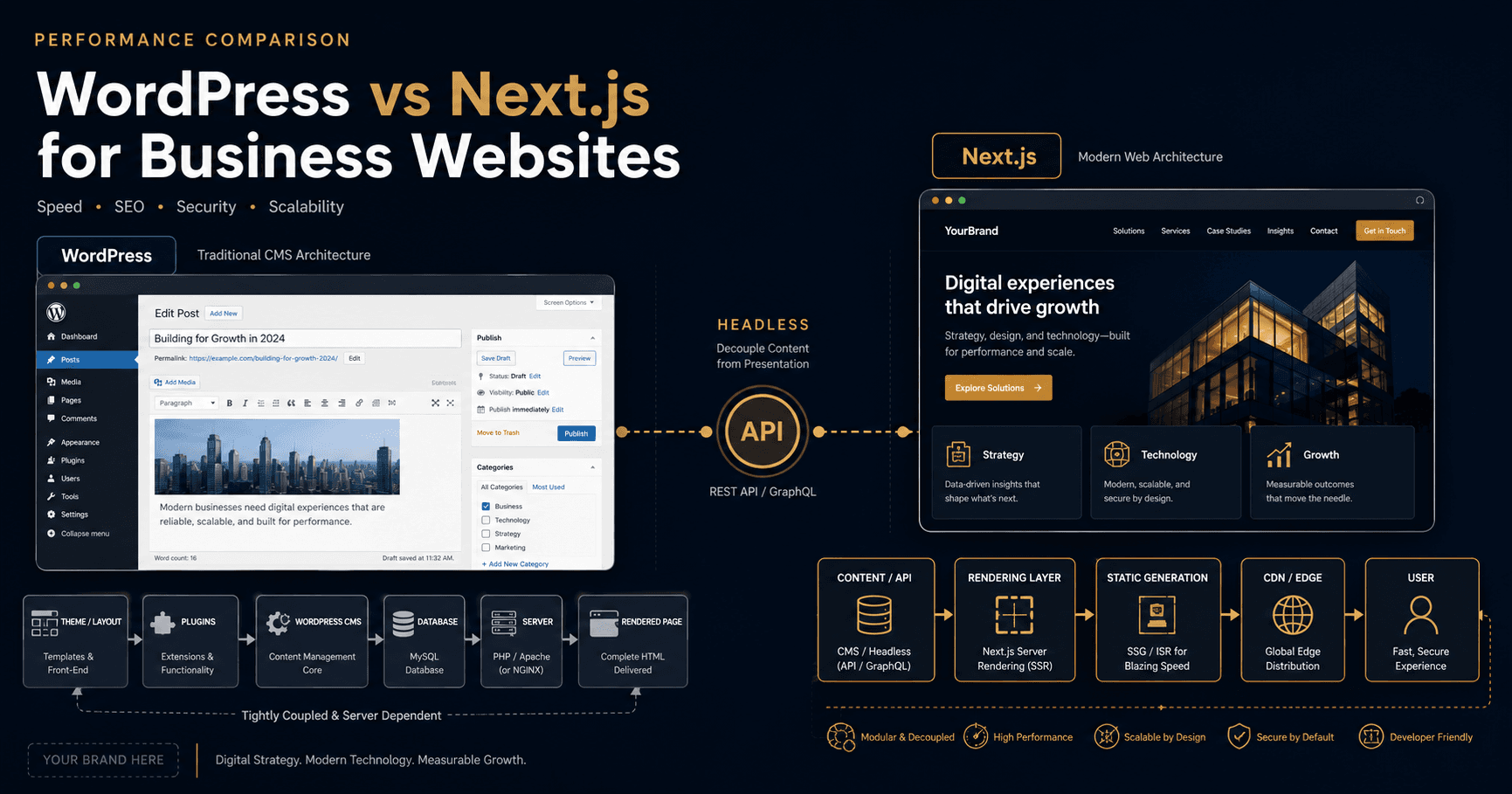
Both WordPress and Next.js power millions of business websites across the United States. But when it comes to deciding which platform to build your company's digital presence on, the right choice depends on your specific performance targets, editorial workflow, and scalability needs.
Understanding the Architectures
At its core, WordPress is a traditional monolithic Content Management System (CMS). When a user requests a page, the server queries the database and assembles the HTML on the fly. To understand how custom engineering compares against proprietary platforms, read our guide on custom web development vs website builders. Next.js, on the other hand, is a modern React framework that supports Static Site Generation (SSG) and Server-Side Rendering (SSR). This means it can pre-build pages so they are delivered to the user almost instantly from a CDN.
When WordPress is the Right Choice
WordPress still powers over 40% of the web for good reason. It is the gold standard for pure publishing workflows. You should choose WordPress if:
- You have a large editorial team publishing dozens of articles per day and needing a familiar visual editor.
- Your site relies heavily on a rapid deployment of marketing plugins without needing developer intervention.
- Your budget is limited to template-based builds rather than custom engineering.
However, traditional WordPress requires rigorous caching and website speed optimization services to pass Core Web Vitals, and its reliance on plugins can introduce security vulnerabilities. Explore our WordPress Development Services for secure, optimized builds.
Why Next.js is the Future of Enterprise Web Apps
Next.js has become the framework of choice for companies prioritizing conversion rates and SEO. A one-second delay in page load time can reduce conversions by up to 7%—see our report on the cost of poor Core Web Vitals and INP. You should choose Next.js if:
- Speed is paramount: Next.js delivers high-performance page rendering, guaranteeing top-tier Core Web Vitals.
- Security is a priority: By decoupling the frontend from the database and avoiding vulnerable third-party plugins, your attack surface shrinks dramatically.
- You need a highly custom UI: As a React framework, Next.js allows for complex, app-like interactive user interfaces that generic builders cannot achieve.
For more on building high-performance sites, read our Next.js Development Services page and discover how server-side rendering fuels our technical SEO services.
Headless WordPress: The Hybrid Approach
What if you want the familiar WordPress dashboard for your marketing team, but the lightning-fast performance of Next.js for your users? Headless WordPress is the answer.
In a headless architecture, WordPress is used purely as a backend database for content creation. The Next.js frontend then fetches this content via an API and renders it as a highly optimized static site. This gives you the best of both worlds. For ecommerce applications evaluating headless setups, read why brands are migrating in Next.js vs Headless Shopify for enterprise ecommerce, or explore our Custom Web Development Services to discuss a headless transition.